
Phishing emails, ransomware attacks, stolen passwords, and data breaches can affect anyone. As more of our lives move online, understanding how cyber threats work and how to defend against them has become increasingly important. That's where cybersecurity comes in.
- Cybersecurity protects devices, networks, and data from attacks that go after money, personal information, and the services people rely on.
- Most incidents start with a person, not a machine, so one careless click can undo the software protecting you.
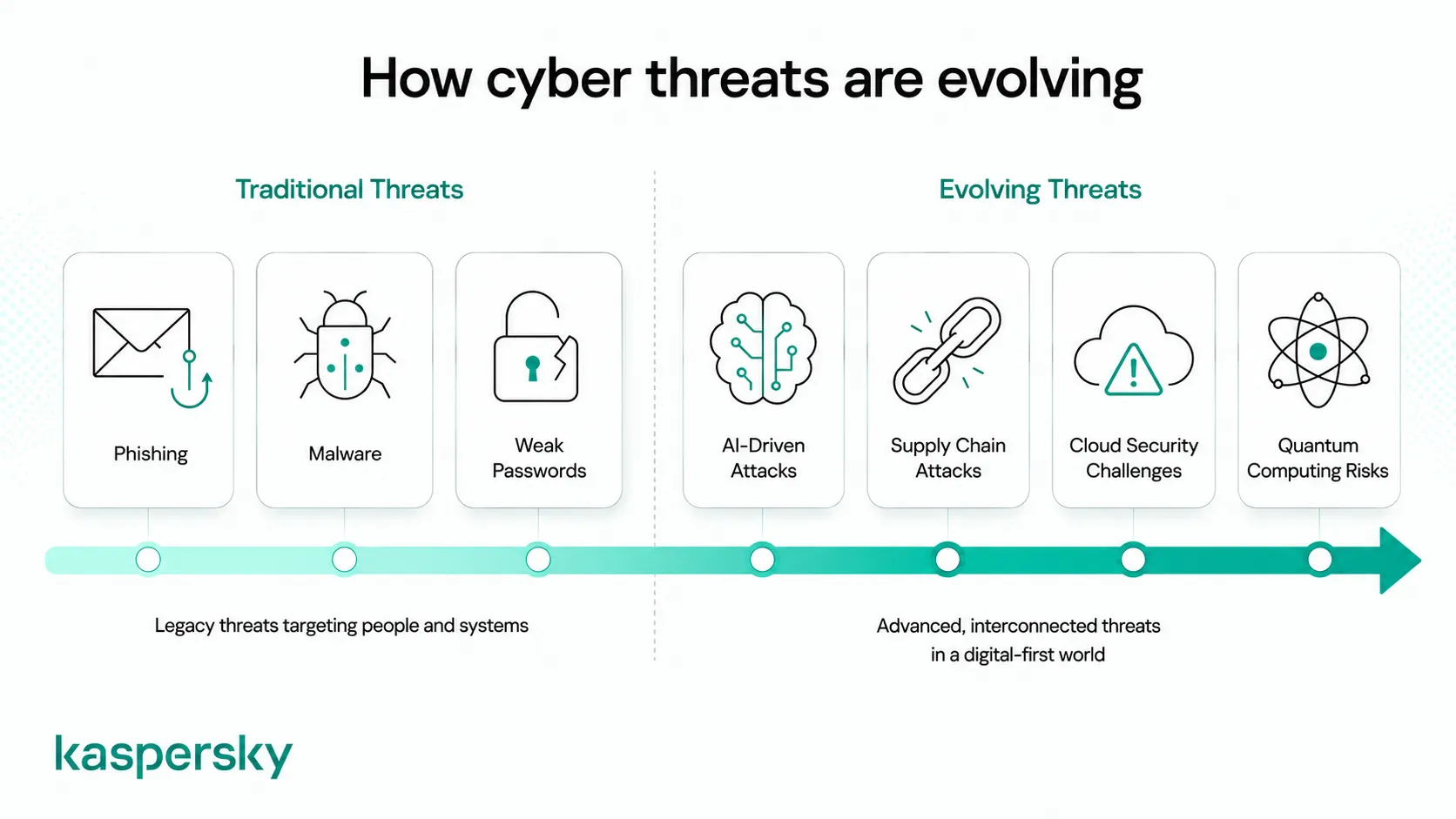
- Phishing, malware, and weak passwords are still the most common ways attackers get in.
- Attackers now use AI, trusted suppliers, and cloud misconfigurations to reach more victims faster.
- Resilience means planning to detect, respond, and recover, not just trying to block every attack.
What is Cybersecurity?
Cybersecurity is the practice of defending computers, servers, mobile devices, electronic systems, networks, and data from malicious attacks. It's also known as information technology security, computer security or electronic information security.
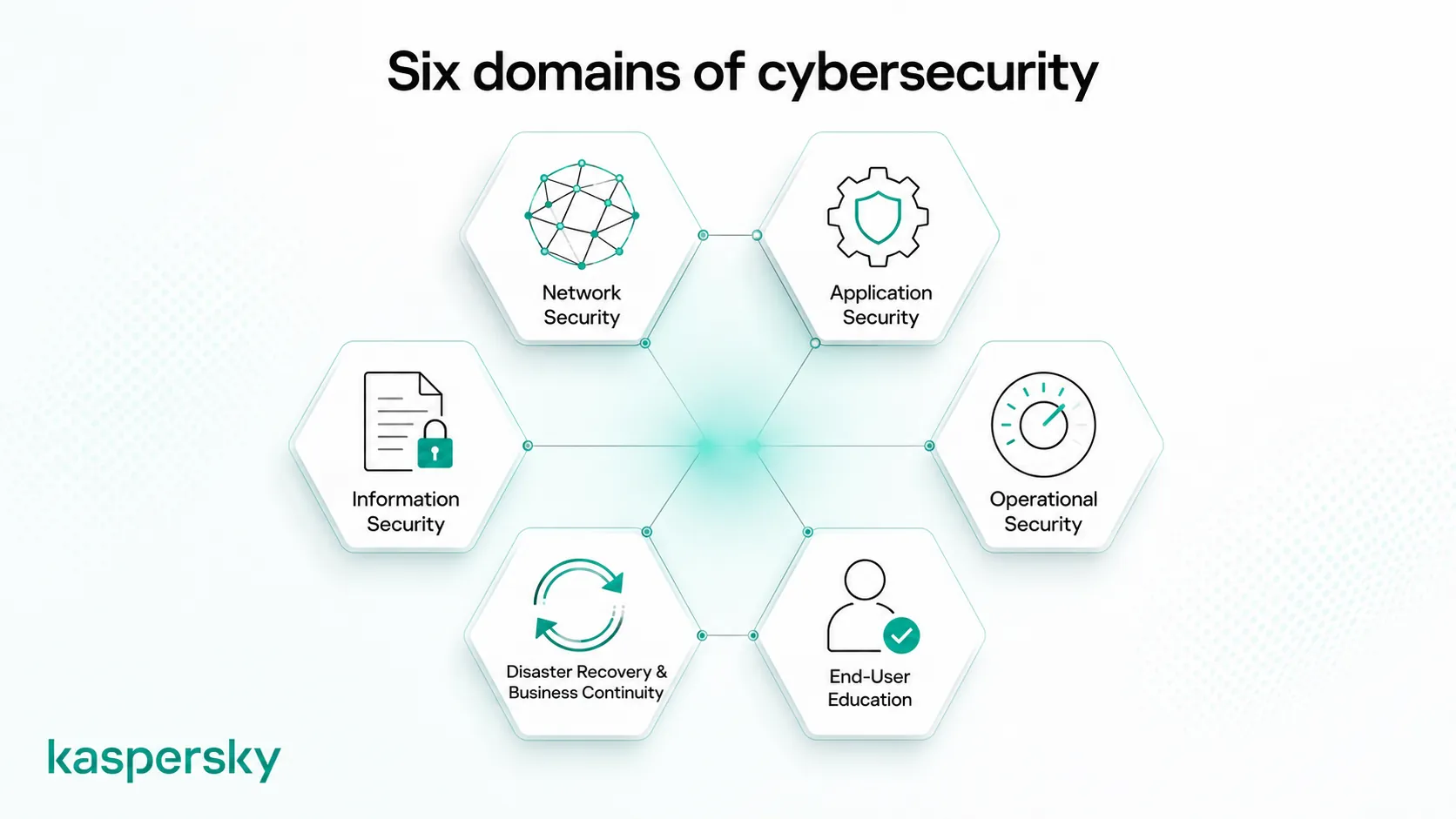
The term "cybersecurity" applies in a variety of contexts, from business to mobile computing, cloud services, connected devices, and digital identities, and can be divided into a few common categories.
- Network security is the practice of securing a computer network from intruders, whether targeted attackers or opportunistic malware.
- Application security focuses on keeping software and devices free of threats. A compromised application could provide access to the data it is designed to protect. Successful security begins in the design stage, well before a program or device is deployed.
- Information security protects the integrity and privacy of data, both in storage and in transit.
- Operational security includes the processes and decisions for handling and protecting data assets. The permissions users have when accessing a network and the procedures that determine how and where data may be stored or shared all fall under this umbrella.
- Disaster recovery and business continuity define how an organization responds to a cybersecurity incident or any other event that causes the loss of operations or data. Disaster recovery policies dictate how the organization restores its operations and information to return to the same operating capacity as before the event. Business continuity is the plan the organization falls back on while trying to operate without certain resources.
- End-user education addresses the most unpredictable cybersecurity factor: people. Anyone can accidentally introduce a virus to an otherwise secure system by failing to follow good security practices. Teaching users to delete suspicious email attachments, not plug in unidentified USB drives, and various other important lessons is vital for the security of any organization.
The scale of the cyber threat
The global cyber threat continues to evolve at a rapid pace, with a rising number of data breaches each year. IBM's annual Cost of a Data Breach Report, which has tracked these incidents for two decades, consistently puts the global average cost of a single breach in the millions of dollars, with USD 4.44 million reported in its 2025 edition.
A single breach can expose sensitive records, interrupt essential services, and wear away the trust people place in a business. Those consequences fall on individuals and organizations alike. For the people whose data is exposed, stolen records can lead to fraud and identity theft long after the breach itself has been resolved. For the organization, it can mean regulatory fines, the loss of customers who take their business elsewhere, and an investigation that drags on for months.
Medical services, retailers and public entities tend to be among the most targeted, with malicious criminals responsible for most incidents. Some of these sectors are more appealing to cybercriminals because they collect financial and medical data, but all businesses that use networks can be targeted for customer data, corporate espionage, or customer attacks. Because the risk is so widespread, governments around the world have responded with guidance to help organizations put effective cybersecurity practices in place.
In the U.S., the National Institute of Standards and Technology (NIST) has created a cybersecurity framework. To combat the proliferation of malicious code and aid in early detection, the framework recommends continuous, real-time monitoring of all electronic resources.
The importance of system monitoring is echoed in the "10 steps to cyber security", guidance provided by the U.K. government's National Cyber Security Centre. In Australia, the Australian Cyber Security Centre (ACSC) regularly publishes guidance on how organizations can counter the latest cybersecurity threats.
Check out this video about cybersecurity and types of cyber threats and attacks:
Types of cyber threats
The threats countered by cybersecurity are three-fold:
- Cybercrime includes single actors or groups targeting systems for financial gain or to cause disruption.
- Cyberattack often involves politically motivated information gathering.
- Cyberterrorism is intended to undermine electronic systems to cause panic or fear.
So, how do malicious actors gain control of computer systems? Here are some common methods used to threaten cybersecurity:
Malware
Malware means malicious software. One of the most common cyber threats, malware is software that a cybercriminal or hacker has created to disrupt or damage a legitimate user's computer. Often spread via an unsolicited email attachment or legitimate-looking download, malware may be used by cybercriminals to make money or in politically motivated cyberattacks.
There are a number of different types of malware, including:
- Virus: A self-replicating program that attaches itself to a clean file and spreads throughout a computer system, infecting files with malicious code.
- Trojans: A type of malware that is disguised as legitimate software. Cybercriminals trick users into uploading Trojans onto their computer, where they cause damage or collect data.
- Spyware: A program that secretly records what a user does, so that cybercriminals can make use of this information. For example, spyware could capture credit card details.
- Ransomware: Malware that locks down a user's files and data, with the threat of erasing it unless a ransom is paid.
- Adware: Advertising software that can be used to spread malware.
- Botnets: Networks of malware-infected computers that cybercriminals use to perform tasks online without the user's permission.
SQL injection
An SQL (structured query language) injection is a type of cyberattack used to take control of and steal data from a database. Cybercriminals exploit vulnerabilities in data-driven applications to insert malicious code into a database via a malicious SQL statement. This gives them access to the sensitive information the database holds.
Because so many websites and applications are built on databases, and the weakness lies in how an application is coded rather than in a particular product, SQL injection has remained one of the most common web attacks for years.
Phishing
Phishing is a type of cyberattack where cybercriminals send emails that appear to come from a legitimate company in order to steal sensitive information. These messages often try to dupe people into handing over credit card numbers, passwords, and other personal details, which attackers can then use to commit fraud or break into the victim's accounts.
Man-in-the-middle attack
A man-in-the-middle attack is a type of cyber threat where a cybercriminal intercepts communication between two individuals in order to steal data. For example, on an unsecure WiFi network, an attacker could intercept data being passed from the victim's device to the network.
Denial-of-service attack
A denial-of-service attack is where cybercriminals prevent a computer system from fulfilling legitimate requests by overwhelming the networks and servers with traffic. This renders the system unusable, preventing an organization from carrying out vital functions.
How cyber threats are evolving
Attackers follow the path of least resistance, so as old openings close, they move to new ones. The shifts below affect home users as much as large organizations, not just security teams.
AI-driven attacks
Artificial intelligence has become a tool for both attackers and defenders. Attackers use it to write more convincing phishing messages, imitate real voices, and scale social engineering with little additional cost. Because AI can personalize a scam using information found online, watching for clumsy spelling or logical inconsistencies no longer offers much protection.
Defenders apply the same technology to their advantage. Security tools use AI to spot unusual behavior, separate genuine alerts from background noise, and respond to incidents faster than a human team could. Automation and threat intelligence feeds let these systems learn from attacks elsewhere, so defenses can keep pace with new methods.
Supply chain attacks
A supply chain attack reaches its target through a trusted supplier rather than head-on. When a software vendor, update server, or service provider is breached, the attacker can pass malicious code to everyone who relies on that product.
This is why third-party risk has become a serious concern: an organization can secure its own systems well and still be exposed through a partner it depends on. Kaspersky's research found that nearly a third of companies faced a supply chain attack in a single year. To reduce that exposure, organizations can review their vendors' security practices and limit what any single supplier can access.
Cloud security challenges
Cloud security challenges arise when data and applications leave local systems for shared online infrastructure. Misconfigured storage, weak access controls, and accounts without multi-factor authentication are common ways cloud data ends up exposed.
Remote and hybrid work add to this, as people reach company resources from home networks and personal devices well outside the office perimeter. So, secure your cloud applications and storage, and know which protections the provider handles and which remain yours.
Quantum computing and encryption
Quantum computing raises a longer-term question for encryption. Much of today's encryption relies on math problems that ordinary computers cannot solve quickly, and a powerful enough quantum computer could weaken some of those protections.
Practical quantum attacks are not possible yet, but preparation is already underway. In 2024, NIST finalized its first post-quantum encryption standards and urged organizations to adopt them now. Part of the urgency is the "harvest now, decrypt later" risk: attackers collect encrypted data today in the hope of reading it once quantum hardware catches up.
End-user protection
End-user protection or endpoint security is a key aspect of cybersecurity. After all, it is often an individual (the end-user) who accidentally uploads malware or another form of cyber threat to their desktop, laptop or mobile device.
So how do these measures protect people and systems? Much of it rests on cryptographic protocols that encrypt emails, files, and other sensitive data, which guards information in transit and helps protect against loss or theft.
In addition, end-user security software scans computers for pieces of malicious code, quarantines this code, and then removes it from the machine. Some security programs can even detect and remove malicious code hidden in a device's primary boot record and are designed to encrypt or wipe data from a computer's hard drive.
Electronic security protocols also focus on real-time malware detection. Many use heuristic and behavioral analysis to monitor the behavior of a program and its code to defend against viruses or Trojans that change their shape with each execution (polymorphic and metamorphic malware). Security programs can confine potentially malicious programs to a virtual bubble separate from a user's network to analyze their behavior and learn how to better detect new infections.
Security programs continue to evolve new defenses as cybersecurity professionals identify new threats and new ways to combat them. To make the most of end-user security software, employees need to be educated about how to use it. Above all, keeping it running and updating it frequently helps it protect users against the latest cyber threats.
Stay protected as threats evolve
Kaspersky Premium brings together real-time malware detection, encryption, and identity protection to help secure your devices and data.
Try Premium for freeWhat is cyber resilience?
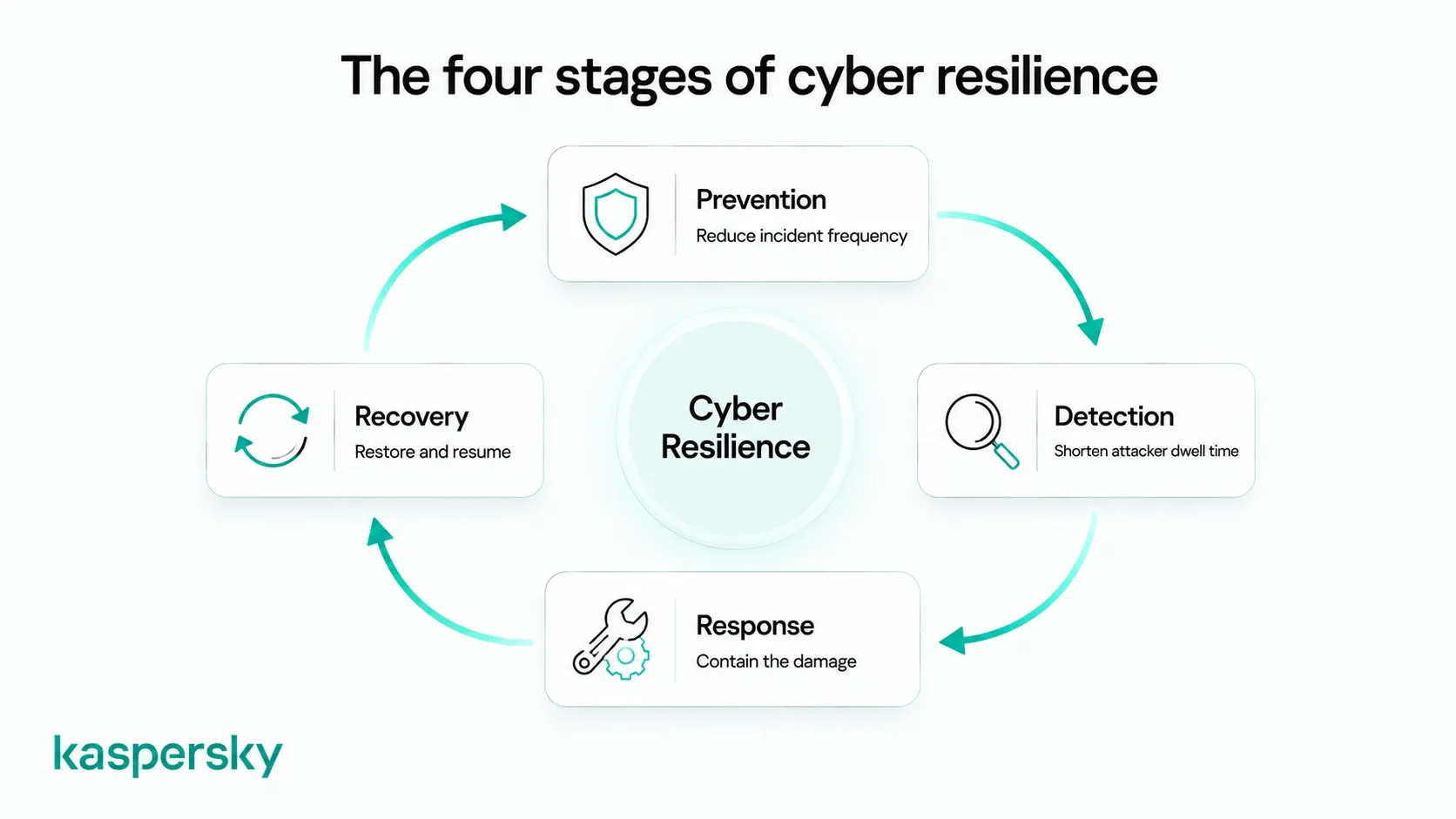
Cyber resilience is the ability to keep operating during a cyberattack and recover quickly afterward. It accepts that some attacks will get through, so it pairs prevention with the means to detect, respond to, and recover from incidents.
Where cybersecurity focuses on keeping attackers out, cyber resilience assumes that no defense is perfect.
It rests on four linked stages:
- Prevention reduces how often incidents happen.
- Detection shortens the time an attacker can act unnoticed.
- Response contains the damage once an incident is found.
- Recovery restores systems and data so normal work can resume.
For a business, this ties closely to continuity planning and a tested incident response process. For an individual, it can be as simple as keeping recent backups. If ransomware locks your files, you may be able to wipe the device and restore a clean copy rather than pay to get them back.
 Why people play a critical role in cybersecurity
Technology blocks many attacks, but most still aim at people, because a person can be rushed, reassured, or scared into clicking, while software just enforces its rules. According to Verizon's 2026 report, the human element plays a role in 62% of breaches, whether it's a click on a convincing email, reusing a password after it has leaked, or approving a fake reset request.
Many of these start with social engineering, where an attacker tricks someone into breaking their own security, a tactic involved in about one in six breaches.
This is where cybersecurity awareness and good cyber hygiene come in. Awareness training helps people recognize phishing and social engineering, question unexpected requests, and report anything suspicious instead of staying quiet.
Cyber hygiene builds on that with everyday routines: using strong, unique passwords, keeping devices and software up to date, and thinking before clicking links or opening attachments. Whether at work or at home, a few consistent habits close many of the easy openings attackers rely on.
Cybersecurity tips: how to protect yourself against cyberattacks
How can businesses and individuals guard against cyber threats? Here are our top cyber safety tips:
- Update your software and operating system: This means you benefit from the latest security patches.
- Use anti-virus software: Security solutions like Kaspersky Premium can detect and remove threats, and keeping the software updated helps it stay effective.
- Use strong passwords: Ensure your passwords are not easily guessable.
- Do not open email attachments from unknown senders: These could be infected with malware.
- Do not click on links in emails from unknown senders or unfamiliar websites: This is a common way that malware is spread.
- Avoid using unsecure WiFi networks in public places: Unsecure networks can leave you vulnerable to man-in-the-middle attacks.
Related Articles:
- What is Cybercrime: Risks and Prevention
- How to prevent cyberattacks and protect your organization effectively?
- What is security awareness training and how does it help companies?
- What is cloud security and why is it important?
Related Products:
- Kaspersky Premium
- Download a free 30-day trial of our premium plan
- Small Business Cybersecurity Solutions
- Advanced Endpoint Security for SMBs
- Enterprise Cybersecurity for Industries
FAQs
Why is cybersecurity important?
Cybersecurity is important because it protects the money, data, and services that daily life now depends on. A single breach can expose personal records, interrupt a business, and erode trust, so reducing that risk matters for individuals and organizations alike.
What are the most common cyber threats?
The most common cyber threats are phishing, malware, and weak or reused passwords. Phishing tricks you into handing over information, malware disrupts or steals from your device, and poor passwords give attackers an easy way in.
How can I improve my cybersecurity?
Updating software, using strong unique passwords with a password manager, and turning on multi-factor authentication can help address the openings attackers rely on most. Good security software helps, but no single tool removes every risk, so caution remains part of the defense.
What is cyber resilience?
Cyber resilience is the ability to keep operating during an attack and recover quickly afterward. Rather than prevention alone, it combines protection with detection, response, and recovery, so an incident becomes manageable rather than a crisis that brings work to a standstill.